Boeing 787 Dreamliner
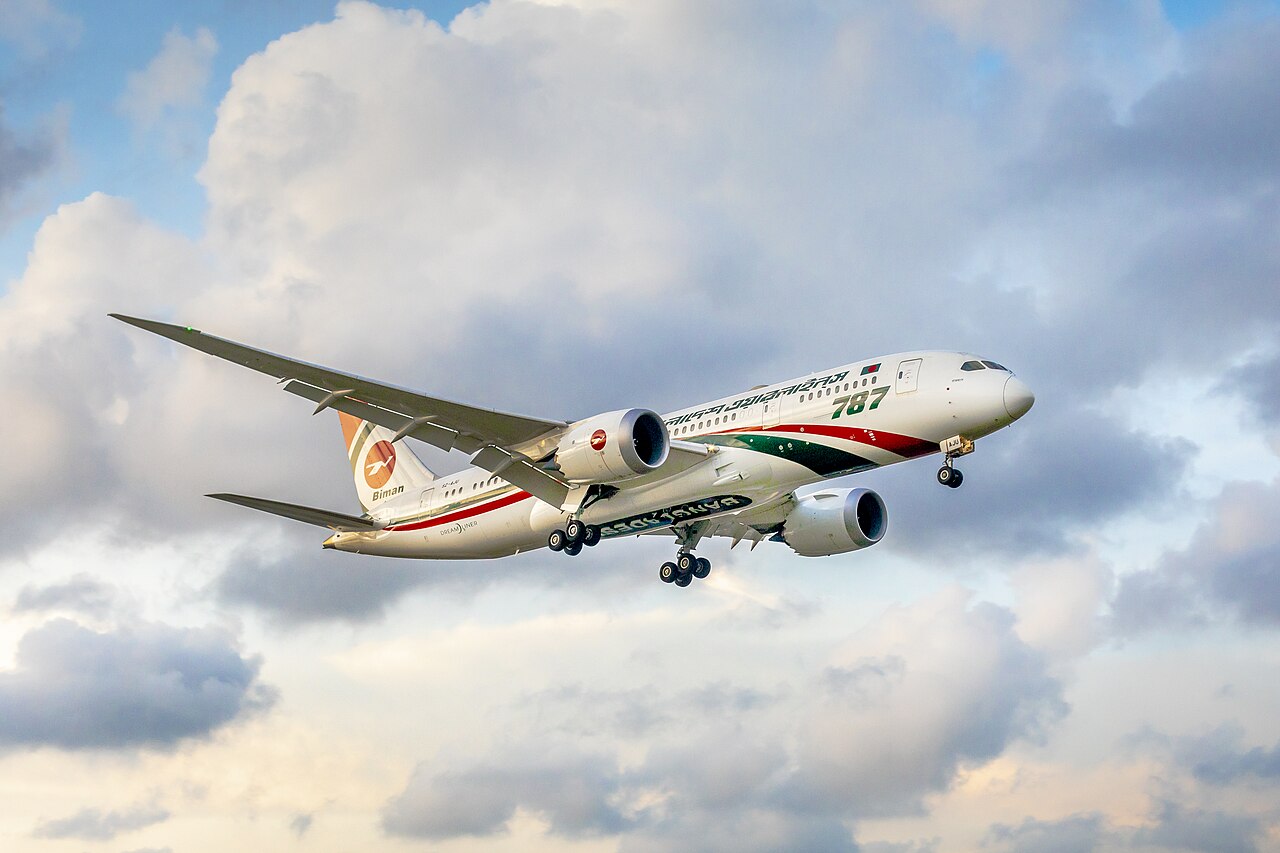
The Boeing 787 is a long-haul twinjet combining an extensively composite structure with a highly electrified onboard architecture.
History
In the early 2000s, Boeing redirected its commercial studies towards a medium-capacity, long-haul twinjet. After the Sonic Cruiser project, which had emphasised speed, the programme known as the 7E7 focused on fuel consumption and operating costs. Its commercial launch in 2004 was supported by All Nippon Airways, the Japanese airline that became its first customer. Renamed the 787 Dreamliner, the aircraft addressed demand for direct services between cities without requiring the capacity of a very large airliner. This approach continued a development already established by earlier twinjets: carrying passengers over long distances with two engines, within an international market structured around competing airline networks and different connection strategies.
The 787 airframe makes extensive use of carbon-fibre composites, particularly in its large fuselage sections and wings. The design combines this structure with new-generation engines and an electrical architecture more extensive than that of earlier Boeing aircraft. Several functions traditionally supplied by air bled from the engines instead use electrical equipment. Large windows with controlled dimming and a pressurisation system suited to the composite structure also distinguish the cabin. Production relies on international partners delivering major assemblies, changing the role of the final assembly plant. Coordinating the different industrial participants consequently became particularly important to the programme schedule and to the practical organisation of aircraft production at the assembly sites.
The first aircraft took off from Paine Field at Everett on 15 December 2009, with Mike Carriker and Randy Neville at the controls. The flight followed several delays connected with development and industrialisation. Certification and the first delivery followed in 2011; All Nippon Airways operated the first commercial flight on 26 October, between Tokyo and Hong Kong. Moving from prototype testing to airline operation also required crew training, maintenance preparation and arrangements for spare parts. For the launch airline, introducing the new twinjet therefore combined a technical innovation with practical changes to its operations and ground resources. The aircraft entered a transport system that extended well beyond its own airframe.
The operating career began with a major difficulty: incidents involving lithium-ion batteries led to the fleet being grounded in January 2013. A return to service was authorised after modifications including enhanced battery protection and a containment system. The episode demonstrated that integrating a technology matters as much as its nominal performance. The 787 subsequently became part of very different networks, including those of Japan Airlines, United Airlines, British Airways and Air Canada. It operates intercontinental services and, depending on the airline, shorter flights as well. The diversity of these assignments shows that its actual employment cannot be reduced to a single route pattern or a single airline network model.
The family comprises three principal versions, the 787-8, 787-9 and 787-10. The 787-8 inaugurated the programme; the 787-9 lengthened the fuselage while offering long-distance operating capability. The 787-10 placed greater emphasis on passenger capacity, with a further fuselage stretch and a different range capability. Interior arrangements vary between carriers, making it inappropriate to assign one seating figure to the entire family. Two engine options are offered, the General Electric GEnx and Rolls-Royce Trent 1000. These versions distinguish capacity requirements from distance requirements without changing the broad identity of a twin-engine, twin-aisle airliner whose structure makes extensive use of composite materials in its major airframe components.
The 787 is not an aircraft whose history ends with retirement: its legacy can already be observed in the industrial and technical choices it brought into view. Extensive composites, the electrification of onboard functions and the international manufacture of complete sections are central aspects of that experience. Initial delays and the battery crisis belong in the same historical assessment as its employment on scheduled routes. The programme thus illustrates the connections between design, certification, supplier management and operational reliability. It also demonstrates that a new commercial aircraft cannot be understood from performance figures alone: its maturity depends on a wider combination of industrial practices and the experience acquired in airline operation.
Why it mattered
- The 787 established extensive composite structures within a new Boeing long-haul family.
- Its electrical architecture changed the power supply for several onboard systems.
- The 2013 battery crisis highlighted the safety issues associated with integrating new technologies.
Where to see it
- The Museum of Flight — Seattle, USAFlight-test aircraft ZA003.