Solar Impulse 2
Solar Impulse 2 is a single-seat demonstrator that completed a staged solar-powered circumnavigation in 2015–2016.
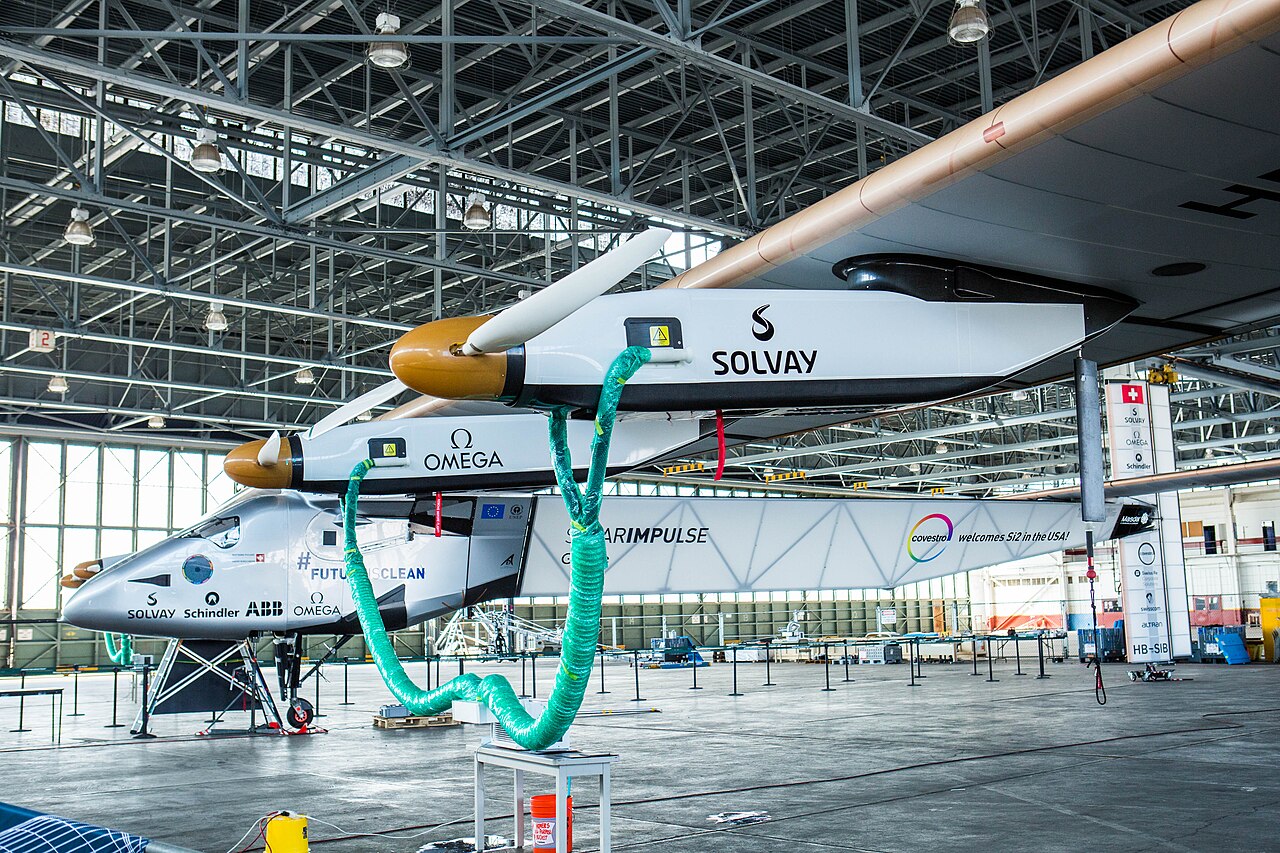
History
Solar Impulse 2 continued the Swiss project established by Bertrand Piccard and André Borschberg to investigate long-duration solar flight. Their approach concerned energy management as much as aircraft construction: the machine had to fly by day, accumulate electricity and continue after sunset. A first aircraft, registered HB-SIA, supplied essential experience through extended flights and a crossing of the United States. The second, HB-SIB, was designed for a journey around the world in stages. It was neither a commercial transport nor an aircraft intended to carry several passengers, but a piloted demonstrator dedicated to a specific mission. Its purpose therefore needs to be understood separately from the requirements of scheduled passenger aviation.
The lightweight composite airframe carries a very large wing covered with photovoltaic cells. Electricity powers four motors driving propellers and charges batteries for use during darkness. The aircraft therefore combines generation, storage and consumption within a single energy balance. During daylight, height gained also contributes to managing the flight; at night, a gradual descent accompanies the use of stored energy. This architecture requires moderate speed and continuous attention to weather conditions. The cockpit accommodates only one pilot, making human endurance a constraint as tangible as battery mass or the power available to keep the aircraft airborne. Flight planning must consequently consider both the machine's energy resources and the person controlling it.
Solar Impulse 2 made its first flight at Payerne in Switzerland on 2 June 2014, with test pilot Markus Scherdel at the controls. Testing checked the behaviour of a machine whose dimensions and lightness required particular procedures both on the ground and in the air. The round-the-world journey began at Abu Dhabi on 9 March 2015. Piccard and Borschberg subsequently alternated at the controls, each flying alone on the stages assigned to him. There was no entry into service in the sense of a scheduled route: operational employment consisted of an experimental campaign and expedition, with its own objectives, personnel and specialised arrangements for supporting the aircraft along the journey.
The route passed through Asia before a Pacific crossing completed in several stages. Borschberg's flight between Japan and Hawaii lasted almost five days, requiring simultaneous management of energy, alertness and very brief periods of rest. Battery damage then caused a lengthy interruption in Hawaii; the expedition resumed in 2016. The aircraft crossed the United States, after which Piccard flew across the Atlantic from New York to Seville. Following Mediterranean stages, Solar Impulse 2 returned to Abu Dhabi on 26 July 2016. The circuit was completed in seventeen stages, not as a nonstop flight or by a single pilot remaining aboard throughout the entire journey around the planet.
Solar Impulse 2 must be distinguished from the first Solar Impulse, whose principle it retained without simply receiving a new name. The second aircraft had an airframe and capabilities adapted to much longer stages. Both machines belonged to the same experimental undertaking, but their flights and characteristics are not interchangeable. There was no family of commercial variants comparable to that of an airliner. The project's development is instead reflected in lessons learned from the first demonstrator, preparation of the second and modifications required by experience. Repairing the batteries during the expedition belongs to this technical history just as much as the successful ocean crossings and the completion of the final stage.
Solar Impulse 2's historical contribution lies in a piloted circumnavigation using solar energy for propulsion, with flights through both daylight and darkness. That achievement does not mean the aircraft reproduced an airliner's missions: speed, payload and operating conditions were very different. The experiment primarily gave visible form to the problems of electrical storage and careful energy use in aviation. It also highlighted the work of weather forecasters, engineers and ground teams behind the presence of one pilot in the cockpit. The expedition's assessment thus rests on an established accomplishment and its documented constraints, without attributing commercial applications to it that the aircraft itself did not demonstrate during its experimental campaign.
Why it mattered
- Solar Impulse 2 completed a solar-powered circumnavigation in seventeen stages in 2015–2016.
- It combined photovoltaic generation and battery storage to fly at night.
- Its long stages made pilot endurance a central component of the experiment.
Where to see it
No example is known with certainty to be on display
Sources
- Smithsonian National Air and Space Museum — Collections
- Solar Impulse Foundation — Solar Impulse
- Smithsonian — Solar Impulse 2 Finishes Its Epic Round-the-World Trip