COMAC C919
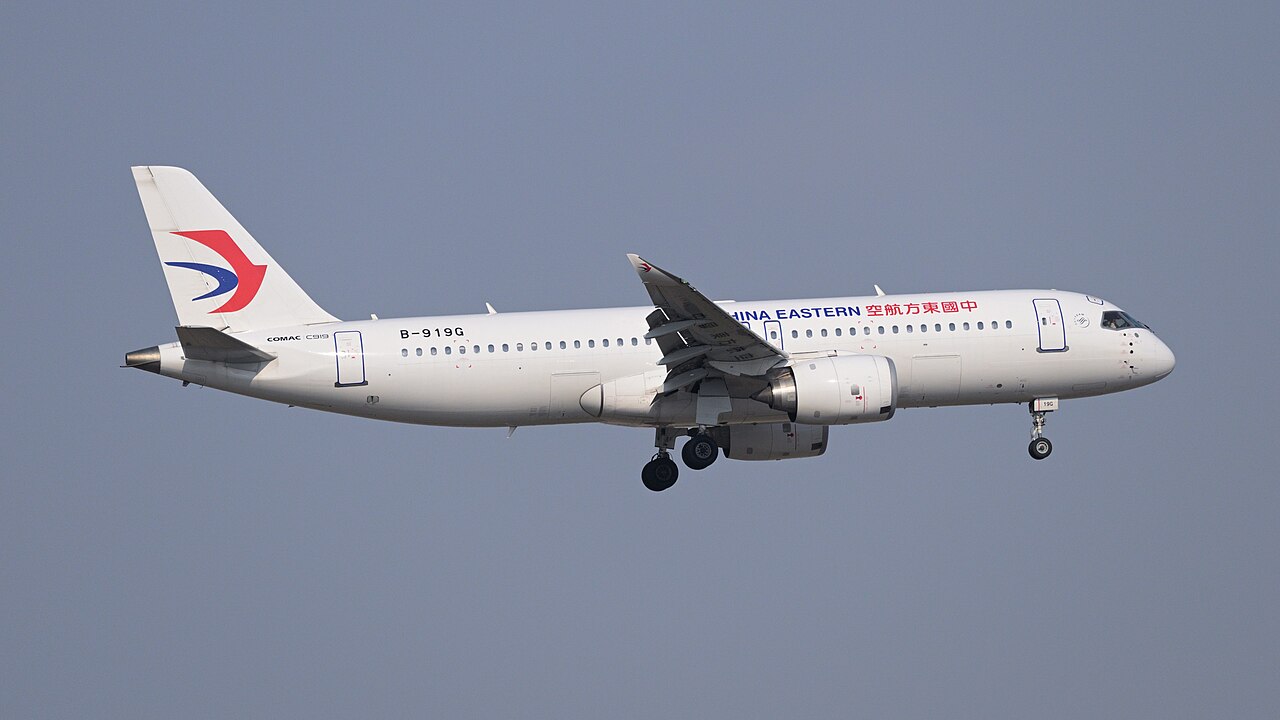
The COMAC C919 is a Chinese single-aisle airliner powered by LEAP-1C engines that entered commercial service in 2023.
History
The C919 forms part of China's effort to develop an industry capable of designing and integrating airliners for major domestic routes. Launched in 2007, the programme entered a market where Airbus and Boeing single-aisle aircraft were already widely employed. COMAC, established in 2008, assumed industrial responsibility. The objective concerned an aircraft larger than the regional twinjet then known as the ARJ21. The undertaking therefore involved both a product and an organisation: design offices, production sites, suppliers and authorities had to work on an aircraft subject to a complete certification process before carrying passengers. Its development belongs to the wider history of building commercial aircraft capabilities rather than simply assembling a new machine.
The C919 adopts a conventional single-aisle layout with a low wing, two engines beneath the wings and a conventional tail. Its structure primarily combines metallic alloys with composites used in selected parts of the aircraft. Electronic flight controls and cockpit equipment form part of a contemporary commercial transport architecture. The LEAP-1C engines come from CFM International, the joint venture between GE and Safran. The programme thus combines Chinese responsibility for design and integration with international suppliers for several important systems. This distribution is essential to understanding the aircraft: the manufacturer's national origin does not mean that every component was developed or manufactured within one country or by a single industrial organisation.
The first example was rolled out in Shanghai on 2 November 2015 and made its maiden flight on 5 May 2017. A lengthy period of testing and compliance demonstration followed before the Civil Aviation Administration of China, or CAAC, issued a type certificate on 29 September 2022. The first aircraft was delivered to China Eastern Airlines on 9 December that year. These dates describe different stages and must not be confused with the start of scheduled services. Chinese certification is an established fact; it does not by itself support a statement that a foreign authority has issued equivalent approval for the same aircraft under its own regulatory system and procedures.
The first commercial flight took place on 28 May 2023 between Shanghai Hongqiao and Beijing, operated by China Eastern Airlines. This entry into operation moved the programme from development flying to the carriage of paying passengers. Its initial career developed within China's domestic network, where distances, demand and infrastructure provide an important operating environment for a single-aisle aircraft. Fleet integration nevertheless requires more than delivery of an airframe: spare parts, training, maintenance and the organisation of rotations determine daily employment. Demonstration flights outside China should therefore not be equated with establishing an international commercial network or obtaining foreign regulatory approvals for the aircraft and its proposed use in airline service.
Manufacturer documentation distinguishes seating and range possibilities within the C919 programme. Seat numbers depend on the selected cabin, and published figures refer to defined configurations rather than a universal capacity. Aircraft actually delivered must also be separated from derivative projects sometimes mentioned in industrial communications. The C919 is neither an ARJ21 version nor a widebody: it occupies the category of single-aisle aircraft intended for short- and medium-distance services. This position explains frequent comparisons with the A320 and 737 families without making their characteristics, certification histories or support networks interchangeable. Each programme must be described through its own established technical features and operational record rather than through the record of its competitors.
The C919's historical assessment concerns the establishment of a new Chinese capability to integrate and certify a commercial aircraft in this category. Forecasting sales or market shares is unnecessary to recognise the importance of its first service in 2023. The aircraft simultaneously illustrates national industrial ambition and the international character of aviation supply chains. Its history also recalls the difference between first flight, type certification, delivery and regular operation, stages separated here by several years. Its role can be described from these milestones and documented assignments without turning development announcements or commercial targets into results already achieved. This distinction allows the programme to be examined as an established aircraft project without making claims about its future.
Why it mattered
- The C919 received its Chinese type certificate in September 2022.
- Its entry into service in 2023 marked the transition to commercial passenger flights.
- It combines Chinese integration with equipment from international suppliers.
Where to see it
No example is known with certainty to be on display
Sources
- COMAC — C919
- CFM International — LEAP-1C integrated propulsion system certification
- COMAC — China’s C919 jetliner goes into commercial operation