Manufacturer
COMAC
Founded in Shanghai in 2008, Chinese aerospace manufacturer COMAC develops civil transport aircraft, including the C919.
4 min read
Origins
The Commercial Aircraft Corporation of China, known by the acronym COMAC, was established in Shanghai in 2008. The company belongs to China’s state aerospace sector and is tasked with designing and producing civil aircraft. Its creation formed part of an industrial policy intended to build domestic capability in a field long dominated by foreign manufacturers. Its Shanghai headquarters places it in one of the country’s major industrial and economic centres.
COMAC did not emerge from an industry without prior experience: Chinese companies had already taken part in aerospace programmes and built aircraft under licence or to domestic designs. The creation of a manufacturer focused on commercial aircraft nevertheless brought design, testing, certification and production capabilities together on a new scale. The company operates within an international supply chain, in which many systems are developed or supplied by specialist partners.
Early programmes
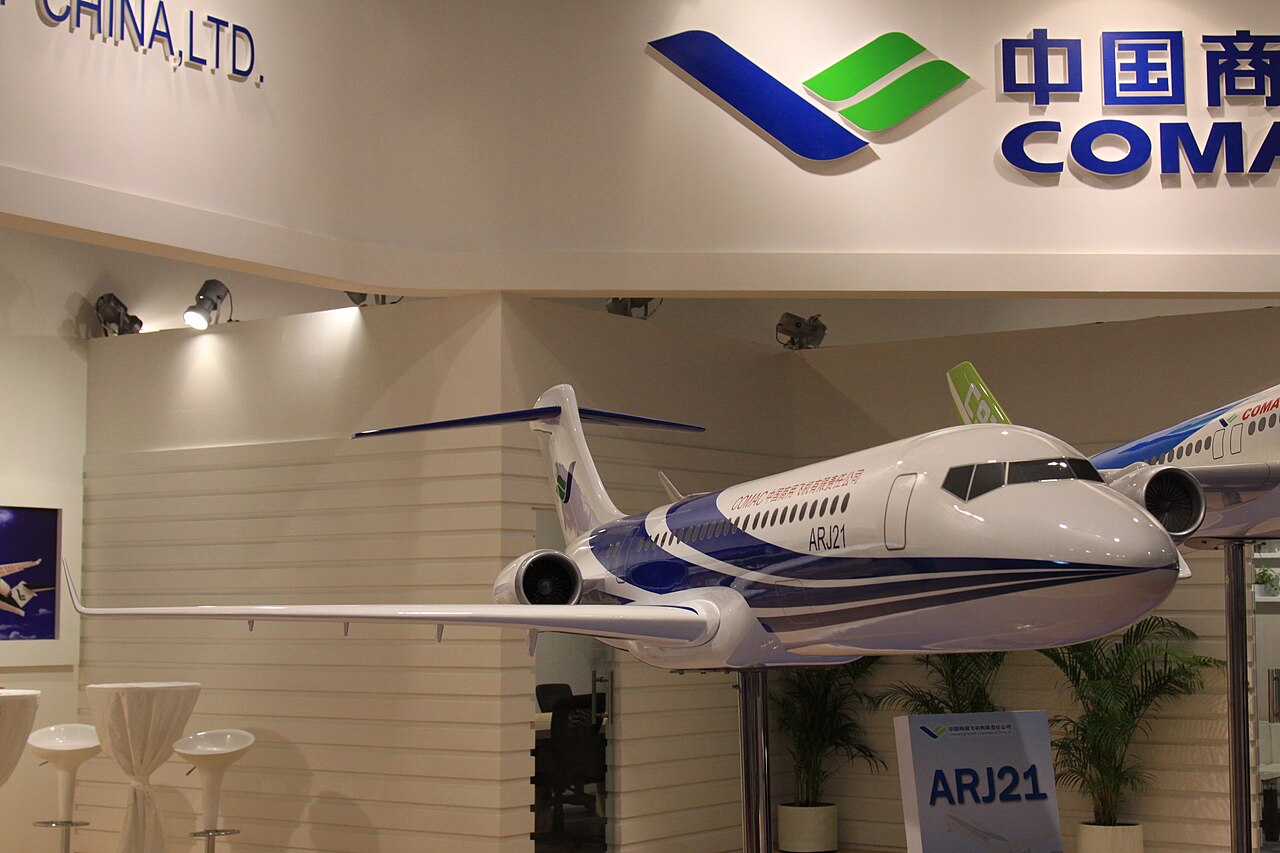
The first commercial aircraft associated with COMAC was the ARJ21, a regional jet designed for short- and medium-distance routes. After an extended development and certification phase, it entered commercial service in China in 2016. The model was later marketed as the C909. Its operation gave the company experience in production, technical support and monitoring an in-service fleet, beyond the work of designing a prototype alone.
The ARJ21/C909 and the C919 address different markets, but their development forms part of the same effort to establish a civil aerospace industry. The regional aircraft has been offered in versions for several missions, including passenger transport and some specialist uses. Such diversification remains dependent on operator requirements and certification capability; it does not mean that every variant has achieved the same reach or level of operation.
The C919 programme
The C919 is a single-aisle aircraft designed for the medium-haul market. Its first flight took place in 2017, beginning a period of flight testing and certification. The aircraft is intended to carry passengers on routes comparable to those served by established single-aisle families. As with any airliner, entry into operation requires not only a successful design and test programme but also regulatory approval and a maintenance and support system.
The first C919 delivery to China Eastern Airlines took place in 2022; the carrier began commercial service in 2023. These milestones mark the transition from development to operation. The initial entry into service, centred in China, provides operational data and support experience for the manufacturer and its suppliers. Order totals and commercial outlooks change over time and are not needed to establish this basic chronology.
The type certificate was granted by the Civil Aviation Administration of China (CAAC) in September 2022. As with the ARJ21, commercial operations began on Chinese domestic routes, allowing in-service experience to build up before any wider distribution of the aircraft. Airlines and the manufacturer have since gathered data on reliability, maintenance and dispatch under day-to-day conditions.
Industrial development
Building an airliner requires sustained coordination among the manufacturer, suppliers, certification authorities and airlines. COMAC must therefore organise assembly, quality control, technical documentation, training and support for aircraft in service. The gradual development of these functions matters as much as the delivery of the first airframes: operational regularity and aircraft availability depend on the ability to provide parts, repairs and updates.
The C919 operates in a market where airlines assess costs, performance, availability and support over an aircraft’s entire service life. Experience gained with the C909 is industrially useful, but the two aircraft differ in size, systems and operating requirements. COMAC also works within an international supplier and standards environment. Regulatory recognition outside its home market follows procedures set by the authorities concerned and cannot be assumed from domestic deliveries alone.
Final assembly of the C919 takes place in Shanghai, at the Pudong site. The programme relies on international suppliers for major systems, notably the LEAP-1C engine from CFM International, while Chinese manufacturers produce a large share of the airframe. This arrangement reflects a common pattern for new entrants to the airliner market, in which an airframer integrates systems sourced from established suppliers while building up domestic industrial capability.
Future programmes
The C929 is a proposed wide-body aircraft for long-distance routes, developed within a Chinese-Russian cooperation initially announced as the CR929. Changes in the partnership and division of responsibilities altered the project’s context. COMAC continues the programme under the C929 designation. With no confirmed entry-into-service date, it is best described as a programme in development; earlier targets or announcements should not be treated as settled deadlines.
The range associated with COMAC therefore includes the C909 regional jet and the C919 single-aisle aircraft, while the C929 represents an ambition for greater capacity. These aircraft involve different levels of industrial maturity. Long-term success will depend on completing design, testing and certification, increasing production and supporting operators. COMAC’s history is measured both by its programmes and by the gradual establishment of the capabilities needed to operate them over time.
Notable aircraft
Other models
- ARJ21 / C909
- C929 (programme)
Sources
- Encyclopædia Britannica — History of flight
- COMAC — COMAC
- COMAC — C919
Related reading
Aircraft
COMAC C919Manufacturer
AirbusManufacturer
Boeing