1841–1925
Clément Ader
An inventor and experimenter, Clément Ader built Éole and Avion III without establishing sustained, controlled flight. His work holds an important place in French aviation memory.
3 min read
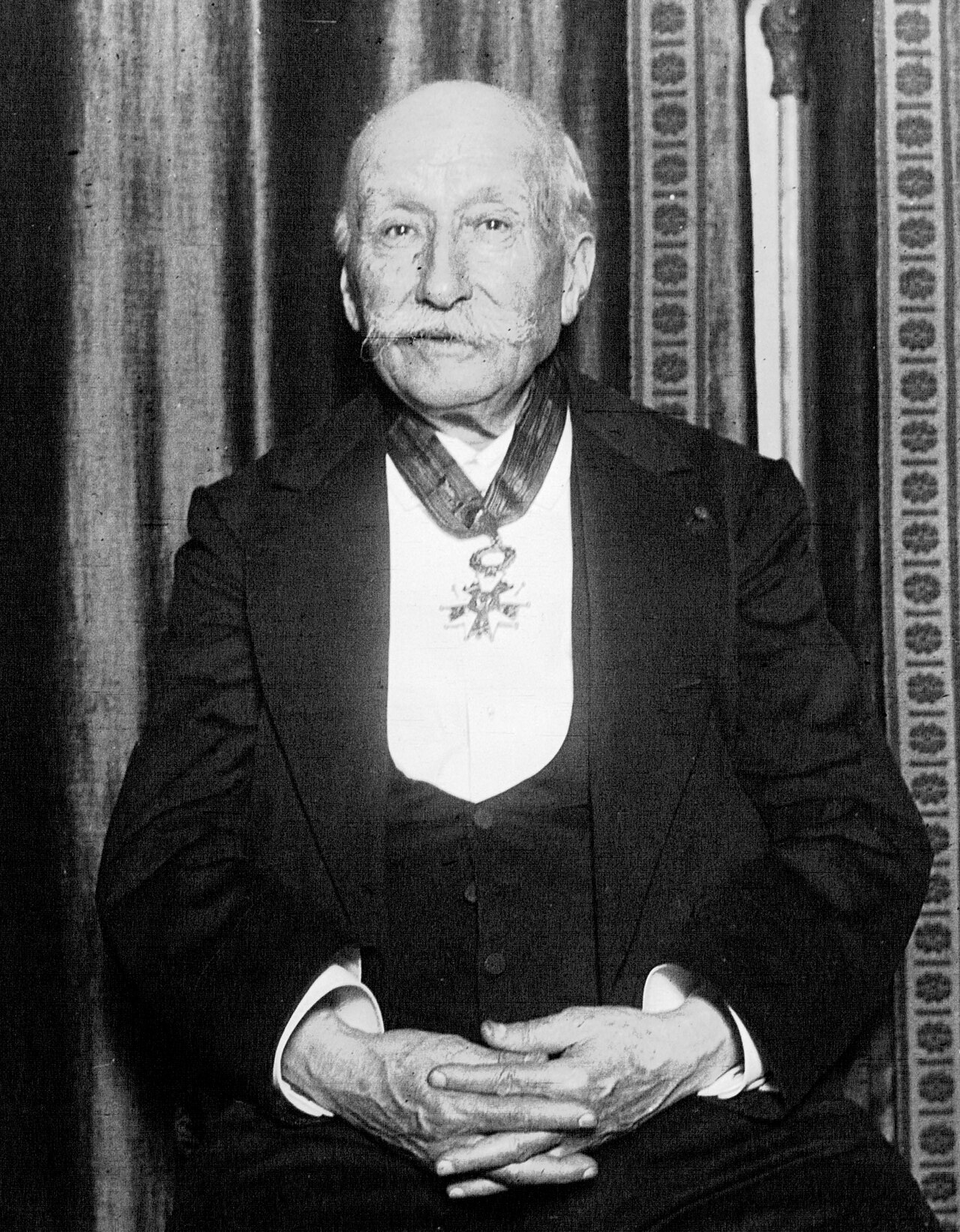
Life
Born at Muret, near Toulouse, Clément Ader approached engineering through practical work and invention. He worked in the railways before turning his attention to several kinds of communications equipment. His telephone research brought him a reputation and resources with which to pursue further experiments. In 1881 the théâtrophone allowed listeners to hear Parisian performances remotely through telephone receivers. This work is a reminder that his career cannot be reduced to an attempted take-off. He belonged to a world of inventors who moved between technical fields and sought useful applications for the devices they developed, rather than following a single established professional specialism.
Ader studied animal flight, taking a particular interest in bats, whose wings influenced his designs. Unlike the Montgolfier brothers, he wanted an onboard engine to lift a heavier-than-air machine. That required a lightweight structure, a lifting surface and adequate propulsion. Controlling the machine's movements was a separate difficulty, however, and copying an animal's shape did not in itself provide an answer. His memory would become firmly embedded in the aviation heritage of the Toulouse region. His principal powered trials nevertheless took place around Paris, well away from his birthplace, and must be understood in their own experimental setting.
Achievements
His first powered machine, Éole, combined bat-like wings with a steam engine driving a propeller. Reducing the weight of the power plant was a substantial engineering task when the available machinery imposed severe constraints. On 9 October 1890, at Armainvilliers, Ader reported a brief lift-off. The episode is often described as a hop, but its precise distance and historical significance remain disputed. It did not establish sustained, controlled flight. The possibility of momentarily leaving the ground must therefore be distinguished from the ability to hold a chosen course and repeat the experiment under the pilot's control. These are different measures of success.
Support from the French Ministry of War subsequently allowed Ader to develop another machine. After the Avion II project, Avion III was fitted with two steam engines and two propellers. Trials at Satory in 1897 did not demonstrate a successful flight; official reports did not confirm the performances Ader would later claim. The army stopped funding the work. The surviving machine remains valuable as an experimental artefact, but its existence does not establish that its control system worked effectively. The arrangement, coordination and effectiveness of flight controls are central to understanding the difference between an attempt to obtain lift and a usable aeroplane.
Legacy
Ader used the name « avion » for his machines, and the term eventually became the standard French word for an aeroplane. He also considered aviation's military uses, publishing his ideas in L'Aviation militaire in 1909. These writings show an interest in organising an air force, a contribution distinct from experimental proof of flight. The preservation of Avion III at the Conservatoire national des arts et métiers gives his work a lasting physical presence. The object allows structural and propulsion choices to be examined directly. It does not, however, turn its inventor's later accounts into established test results or remove the need to assess contemporary evidence.
Comparison with the Wright brothers is most useful when it concerns methods and evidence rather than national rivalry. The Wrights combined aerodynamic measurements, pilot training and repeated flights; their demonstrations established a degree of control that Ader's trials did not document. This does not diminish the work invested in lightweight steam machinery or Ader's cultural importance among aviation's pioneers. His career instead shows how inventing an aeroplane required several problems to be solved together. An onboard engine and wings were not enough: the forces had to be understood, movements controlled, and observations recorded in a form that allowed the results to be evaluated.
Sources
- Encyclopædia Britannica — Clément Ader
- Musée de l'Air et de l'Espace — Collections
- Gallica — BnF — Presse et revues aéronautiques numérisées
- Musée des Arts et Métiers — Avion de Clément Ader
Related reading
Era
The pioneers (1783–1914)Pioneer
Wilbur and Orville WrightAircraft
Ader ÉoleFeature
Toulouse, aerospace capital