Manufacturer
Antonov
An aircraft manufacturer and design bureau founded around Oleg Antonov, known especially for utility and heavy transport aircraft.
5 min read
Origins
Oleg Konstantinovich Antonov was born in 1906 in the Russian Empire and developed an early interest in gliders. He studied at the Leningrad Polytechnic Institute and worked in Soviet aircraft design before the Second World War. His experience with gliders and utility aircraft informed an approach attentive to take-off and landing capability, straightforward operation and uses beyond major airline routes.
In 1946 a bureau specialising in transport and utility aircraft was established at Novosibirsk under his leadership. It moved to Kyiv in 1952, becoming a major centre of aircraft design. The bureau operated within the Soviet industrial system: programme choices, manufacturing plants and suppliers were coordinated by state institutions. The Antonov name became attached to a diverse range, from small agricultural aircraft to heavy transports.
The Kyiv location, then in the Ukrainian Soviet Socialist Republic, developed around design teams, test facilities and industrial production. The concentration of technical expertise and factories helped move designs into manufacture. Antonov was not simply a commercial manufacturer: it also served military, agricultural and logistical needs. This variety of missions accounts for the substantial differences in size and design among its aircraft.
Growth
The An-2, which first flew in 1947, became one of the most enduring utility aircraft in aviation history. A single-engine piston biplane, it could be used for local transport, agriculture, liaison and various specialist tasks. Its structure and low-speed performance suited it to rough airstrips. The An-2 was built for decades in the Soviet Union and later in Poland, and spread far beyond its country of origin.
The An-2’s longevity reflected its versatility and operators’ adaptation to limited infrastructure. It was not a universal aircraft: payload, speed and comfort remained those of an older utility design. Nevertheless, parts availability, relatively straightforward operation and the ability to perform varied missions helped it remain in service in many regions. It became a notable example of design oriented towards practical use rather than speed alone.
As military transport requirements grew, the bureau developed larger aircraft. The An-8 and then the An-12 were designed to move cargo, personnel and equipment. The four-engine turboprop An-12 first flew in 1957 and entered service as early as 1959. Its rear loading ramp facilitated bulky freight, and it was operated by military and civil users. It played an important role in Soviet transport and in the fleets of many countries.
The bureau also developed regional transports and specialist projects. This work relied on flight testing and cooperation with armed forces, operators and production facilities. Civil transport requirements differ from those of military aircraft: operating rules, availability and cargo access demand different compromises. Experience with utility aircraft nevertheless gave the bureau recognised expertise in robust structures and operation from less-developed airfields.
Major programmes
The An-22 Antei, which first flew in 1965, was the first very large turboprop transport. It was designed for strategic movement of heavy loads, including vehicles and military equipment. Its size created particular infrastructure and handling requirements. The aircraft set payload and distance records, but its operational value lay chiefly in carrying items that smaller transports could not accommodate.
The An-124 Ruslan extended heavy-freight capability further. The four-engine jet first flew in 1982 and entered service during the 1980s. Its design includes a large cargo hold and features that facilitate loading oversized items. It has been operated by military organisations and commercial heavy-cargo specialists. Demand for this kind of transport remains specialised: the aircraft requires suitable infrastructure, careful planning and experienced teams.
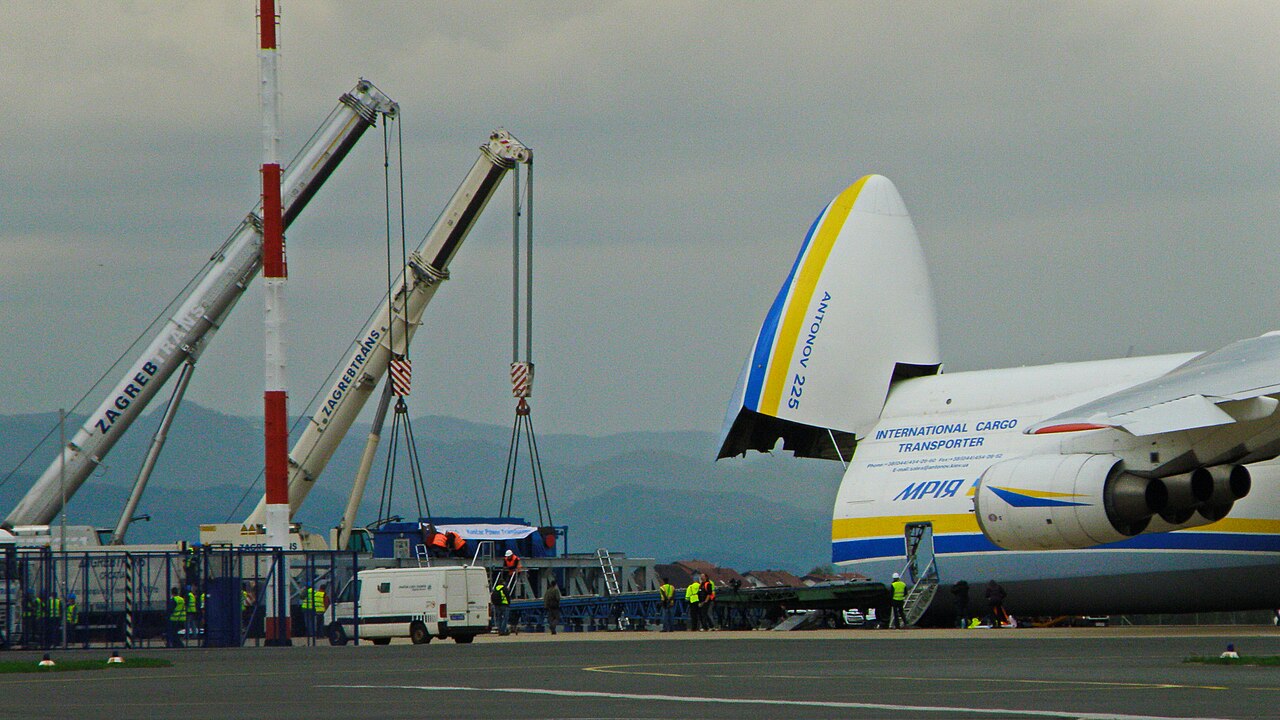
The An-225 Mriya was developed from the An-124 to carry the Soviet Buran space shuttle and launcher components. It first flew in 1988 and became unique in its dimensions and original purpose. After the Buran programme was abandoned, it was adapted for commercial carriage of exceptional loads. It undertook international missions for cargo that ordinary transports could not carry. Its history links a Soviet space programme, commercial adaptation and rare operations.
Later development also included regional aircraft such as the An-24 and An-26, as well as newer transport projects. Antonov’s approach centred on adapting aircraft to intended infrastructure, payload and operating conditions. Technical solutions do not automatically transfer from one type to another: a regional airliner, military transport and oversized-cargo aircraft face distinct constraints. The bureau’s reputation thus rested on the range of missions it addressed.
Mergers and acquisitions
The dissolution of the Soviet Union in 1991 placed Antonov in a new political and industrial environment. The bureau and much of its activity were in independent Ukraine, while factories, suppliers and customers were distributed across several successor states. Coordination that had previously been centralised became more complex. The company had to preserve expertise and supply chains while seeking new markets amid difficult economic conditions.
Antonov continued design, testing and support work and took part in industrial cooperation. The An-124 remained in service with Ukrainian and Russian operators before relations between the two countries deteriorated. Soviet-era production and maintenance networks were interdependent; their separation created technical and economic difficulties. The Ukrainian-owned An-225 was operated by Antonov Airlines for exceptional cargo and became a symbol of Ukrainian heavy-lift expertise.
Relations between Ukraine and Russia deteriorated from 2014, following Russia’s annexation of Crimea and the beginning of armed conflict in eastern Ukraine. Russia’s full-scale invasion in February 2022 profoundly changed operating and production conditions. These events have caused human and material consequences, affecting infrastructure, aviation activity and industrial cooperation. Their impact should be described without reducing war to a mere episode in a manufacturer’s commercial history.
Today
Russia’s full-scale invasion of Ukraine began on 24 February 2022. Hostomel Airport, near Kyiv, was the scene of fighting early in the invasion. The An-225 Mriya, parked in a hangar there, was destroyed during the fighting. The loss of the only completed example is a significant material and heritage fact; it should not obscure the human casualties and wider destruction caused by the war. The wreckage cannot be described as an aircraft still available for operation.
Antonov remains a Ukrainian company whose activities are affected by war and by security, production and displacement constraints. Antonov-designed aircraft continue to be used in various countries, including the An-2 and An-12, while available An-124s serve specialist heavy-transport roles. The condition of each aircraft depends on its operator, technical status and applicable permissions. The existence of an aircraft family does not guarantee the availability of every example.
Oleg Antonov died in 1984. His legacy continues in utility and transport aircraft, technical archives and engineering expertise retained in Ukraine. Museum collections and preserved aircraft document the bureau’s history, while the An-225 remains associated both with heavy-lift engineering and its destruction at Hostomel. Any prospect of reconstruction depends on decisions and conditions that cannot be assumed. A rigorous account therefore distinguishes the documented legacy from possible projects.
Notable aircraft
Other models
- An-2
- An-12
- An-22
- An-124
- An-225
Sources
- Encyclopædia Britannica — History of flight
- Encyclopædia Britannica — Antonov
- Antonov — Antonov Company
Related reading
Manufacturer
TupolevManufacturer
IlyushinFeature
Aviation safety