Manufacturer
Tupolev
A Soviet and later Russian aircraft design bureau founded around Andrei Tupolev, known for experimental, military and civil aircraft.
5 min read
Origins
Andrei Nikolayevich Tupolev, born in 1888, became one of the leading engineers and organisers of Soviet aircraft design in its early decades. After studying at the Imperial Moscow Technical School, he joined the Central Aerohydrodynamic Institute, TsAGI, established in 1918. The institute combined theoretical research, wind-tunnel testing and aircraft development. Tupolev took responsibility for work on metal structures and helped make the organisation a major centre of Soviet aviation.
In 1922 a design bureau led by Tupolev was organised within TsAGI. It was not a private company in the Western sense, but a design team embedded in Soviet state and industrial institutions. Its aircraft were initially associated with the ANT designations, derived from Andrei Nikolayevich Tupolev’s initials. Successive designs explored new materials, layouts and roles, while workshops and test institutes built prototypes and refined them.
The use of metal, including duralumin structures, became a significant direction for the bureau. Early aircraft demonstrated the potential of metal fuselages and wings for transport and military roles. This transition was not without difficulties: production methods, material quality, engines and crew experience constrained actual performance. Tupolev’s approach combined ambitious design with practical testing in a system where military requirements and administrative decisions strongly shaped programmes.
Growth
During the 1930s the bureau gained international attention through long-range aircraft and aviation expeditions. The ANT-25, designed around a high-aspect-ratio wing and low fuel consumption, was intended for long-distance flights. In 1937 Soviet crews used it for nonstop flights between the Soviet Union and North America. These flights set distance records and also demonstrated technical and political capability. They depended on crew preparation, navigation and reliability as well as the aircraft’s performance.
The period was also marked by Stalinist repression. Tupolev was arrested in 1937 and imprisoned; he continued working in a special design bureau under penal control. He was released in 1941. This history helps explain the conditions in which Soviet engineering was organised, without reducing the bureau’s history to that of its leader. Its teams included specialists in structures, aerodynamics, systems and flight testing.
During the Second World War, Tupolev bombers played an important role in Soviet aviation. The Tu-2, developed during the conflict, was designed as a frontline bomber and multi-role aircraft. Its development and operational use reflected Red Army requirements and wartime production constraints. After 1945, the acquisition and study of foreign aircraft, together with the development of jet engines, accelerated change. Designs had to accommodate higher speeds, new systems and the requirements of serial production.
Major programmes
The Tu-104, derived from experience with the Tu-16 bomber, entered service in 1956; while the Comet was grounded, it was the only jet airliner in regular scheduled operation. It marked a change in Soviet transport, while its early operation also exposed the constraints of first-generation jets: high fuel consumption, limited infrastructure and demanding handling requirements. It nevertheless helped airlines and airports adapt to new cruising speeds and altitudes.
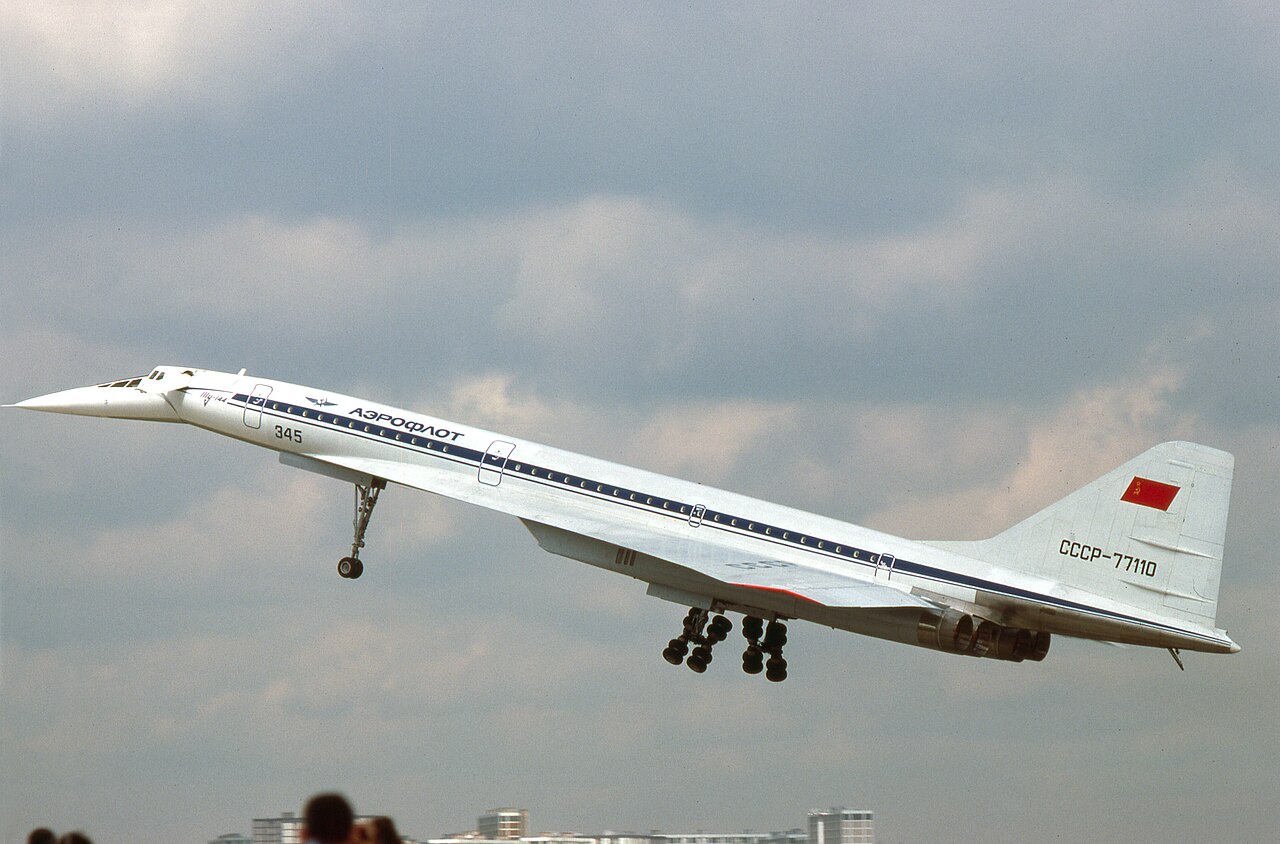
The Tu-144 was developed as a supersonic transport. It first flew in 1968, before Concorde, but had only a limited period of commercial passenger service. Technical and operational difficulties, costs and an accident at the 1973 Paris Air Show shaped its history. Later versions were used for freight and research. The programme illustrates how technological achievement does not necessarily translate into a sustainably viable supersonic transport system.
The Tu-154 became one of the principal Soviet medium-range airliners. It first flew in 1968 and entered service in the early 1970s. Designed for a range of airports and operating conditions, it was produced in several versions and used by Soviet airlines and operators in other countries. The newer-generation Tu-204 first flew in 1989. Its development coincided with the dissolution of the Soviet Union, complicating finance, certification and production.
Beyond civil aircraft, the bureau continued military and research programmes, including bombers, reconnaissance aircraft and experimental prototypes. This breadth reflected its role as a national design bureau rather than a single commercial specialism. Designations and teams changed through reorganisations, but the Tupolev name remained associated with aircraft design and coordination with production plants, engine makers, authorities and the armed forces.
Mergers and acquisitions
The end of the Soviet Union fundamentally changed Tupolev’s operating environment. The bureau became a Russian organisation in an economy where public funding, military orders and airline demand fluctuated sharply. Production of aircraft designed in the Soviet era continued unevenly, while new designs faced different certification and financing requirements. These difficulties were not unique to Tupolev; they affected the aerospace industry across the former USSR.
Over subsequent decades, the Russian state sought to consolidate major aircraft manufacturers. United Aircraft Corporation (UAC) was established in 2006 and progressively brought together companies and design bureaus, including Tupolev. Integration was intended to coordinate design, production and industrial strategy; it did not mean that every activity or technical identity disappeared immediately. Tupolev programmes remained identifiable but were managed within a larger group and centralised governance structures.
This reorganisation coincided with changing requirements. Civil aircraft had to compete in fuel consumption, maintenance, passenger comfort and operator support, while military programmes addressed separate national priorities. The Tu-204 and its variants were developed in this context, with more limited operation than major Western airliner families. Announced projects, prototypes, certified aircraft and aircraft actually delivered should be distinguished: these milestones were not always reached at the same pace.
Today
Tupolev survives as a name and design bureau within Russia’s aerospace industry, integrated into UAC. Its legacy includes civil aircraft that served domestic and international routes for decades, as well as military aircraft whose roles and operational status vary. The Tu-104, Tu-144 and Tu-154 are now chiefly associated with aviation history; preserved examples in museums document stages in their development and operation.
Andrei Tupolev died in 1972. His historical contribution lies in building a sustained Soviet aircraft-design capability, organising multidisciplinary teams and applying metal structures across a broad range of aircraft. This history also includes the consequences of political repression and the economic and technical limits of some programmes. A balanced account distinguishes measurable achievements, actual use and stated ambitions.
Tupolev’s activities do not constitute an independent international commercial product range. They form part of Russian industrial policy and UAC organisations. The future of projects depends on decisions and certifications that cannot be assumed. The name nevertheless remains an important reference for understanding Soviet and Russian engineering, from TsAGI research to jet transports and contemporary programmes.
Notable aircraft
Other models
- ANT-25
- Tu-104
- Tu-144
- Tu-154
- Tu-204
Sources
- Encyclopædia Britannica — History of flight
- Encyclopædia Britannica — Tupolev
- United Aircraft Corporation — Tupolev
Related reading
Manufacturer
IlyushinManufacturer
AntonovFeature
Supersonic flight, from the Bell X-1 to the Boom XB-1