Manufacturer
Ilyushin
A Soviet and later Russian design bureau founded by Sergei Ilyushin, associated with military and civil transport aircraft.
5 min read
Origins
Sergei Vladimirovich Ilyushin was born in 1894 in the Russian Empire. He first worked in agriculture, then joined military aviation during the First World War. After the revolution he served in the Red Army and trained as an aircraft engineer. Graduating from the Zhukovsky Air Force Academy in 1926, he took part in developing Soviet aircraft design and testing. His career combined practical experience, technical education and service in military institutions.
In 1933 Ilyushin headed a design bureau within Soviet aerospace. Like other bureaus of the period, it depended on the state and worked with research institutes, factories, engine makers and the armed forces. Its team designed aircraft for requirements identified by the authorities, then subjected them to testing and often substantial modification. The Il designation gradually became associated with its aircraft.
The bureau became known for attention to robustness and practical use, without implying an absence of innovation. Serial-production constraints, available materials and Soviet operating conditions influenced design. Engineers had to balance protection, payload, performance and ease of manufacture. Later successes were collective achievements: design decisions cannot be attributed to the director alone, even though his name became that of the bureau.
Growth
The Il-2 was the bureau’s most closely associated programme during the Second World War. This ground-attack aircraft was designed to operate over the battlefield and to incorporate protection against gunfire. Armour integrated into the structure protected vital areas and contributed to its reputation for surviving demanding conditions. Early versions were single-seat; operational experience led to a rear gunner position on later models, with penalties in weight and performance.
The Il-2 was produced on a large scale by Soviet industry and used on several fronts. Production conditions changed amid shortages, factory relocations and wartime urgency. Units employed it chiefly against ground targets, but results depended on enemy defences, tactics and coordination with ground forces. Its historical role was significant, but it should not be described as invulnerable or detached from the losses suffered by aircrews.
After the war the bureau also turned to transport aircraft. The Il-12 and then the Il-14 were designed for passengers and freight on routes where robustness and the ability to use varied airfields mattered. The Il-14 first flew in 1950 and entered service in the middle of the decade. It operated in the Soviet Union and was exported to several countries. Its long service reflected a design suited to everyday operation, as well as an industrial environment in which equipment choices were largely planned.
Major programmes
The four-engine Il-18 turboprop marked an important stage in post-war Soviet transport. It first flew in 1957 and entered service in 1959. Designed for medium- and long-distance routes, it offered greater capacity than the piston aircraft it gradually replaced. Soviet airlines operated it on domestic and international routes, and specialist versions were also developed. The turboprop combined higher cruising speed with lower fuel consumption than comparable early jets.
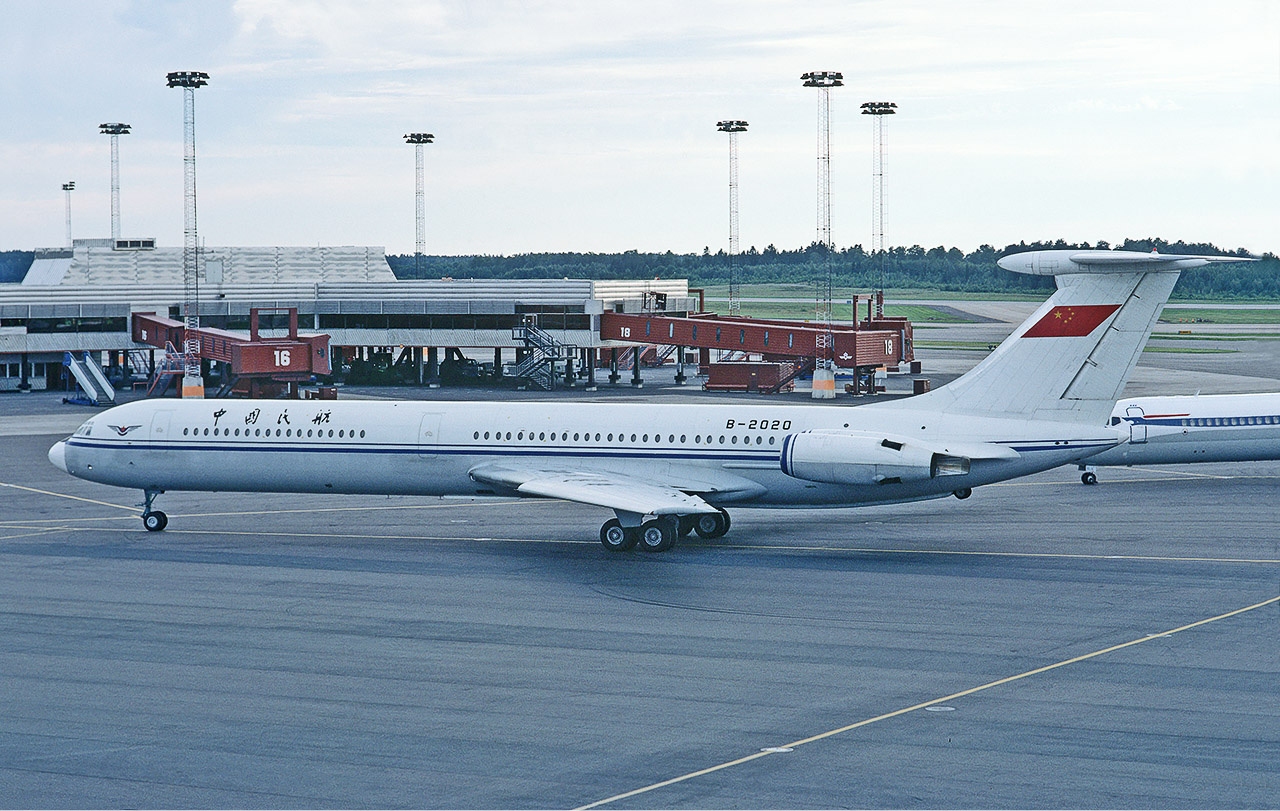
The Il-62 was the first Soviet long-range jet airliner to enter series production. It first flew in 1963 and entered service in 1967. Its four rear-mounted engines and T-tail reflected design choices of the period. It connected Moscow with distant destinations and was also used by airlines in other countries. The aircraft demonstrated the ability to design an intercontinental airliner, while requiring maintenance networks, infrastructure and procedures suited to its size and engines.
The Il-76 was designed as a military jet transport capable of carrying heavy loads and operating from less developed airfields than major airliners. It first flew in 1971 and entered Soviet military service in 1974. The airframe was adapted for transport, tanker and specialist missions. Adoption by civil and military operators outside the Soviet Union broadened its use, with configurations serving distinct requirements.
The Il-86, the first Soviet wide-body passenger aircraft, first flew in 1976 and entered service in the early 1980s. The Il-96, its successor in the long-haul category, first flew in 1988. The programmes emerged in different technological and economic settings. The Il-96 incorporated newer systems and engines, but demand and production capacity limited its reach. Both aircraft expressed Soviet and later Russian ambitions in high-capacity civil transport.
Mergers and acquisitions
The dissolution of the Soviet Union in 1991 transformed the financing and organisation of aerospace. The Ilyushin bureau remained in Russia, but suppliers, production sites and some customers were now distributed among independent states. The transition to a market economy reduced or disrupted some public orders and made long-term planning difficult. Civil programmes now faced foreign competitors directly amid limited financial resources.
The Il-96 and Il-76 programmes evolved during this period through modernised variants and efforts to sustain production and support. The Il-96 did not become a widely distributed competitor to international wide-bodies, but retained specialised uses. The Il-76 remained relevant for cargo and certain specialist missions. This continuity reflected the availability of airframes and industrial expertise; it did not mean that every aircraft remained in service or that all variants were produced at the same rate.
The establishment of United Aircraft Corporation in 2006 began a consolidation of Russian aerospace companies. Ilyushin was integrated into the organisation alongside other manufacturers and design bureaus. The aim was to coordinate resources, programmes and production. This was a state-controlled consolidation rather than an ordinary commercial acquisition. Ilyushin continued as a design legacy and technical activity, while governance and industrial strategy belonged to a larger group.
Today
Ilyushin remains associated with transport aircraft that served several generations of operators. The Il-14 is preserved in collections and museums; the Il-18 also had a long civil career, and some airframes survived commercial service. The Il-76 remains the type most durably associated with the bureau in heavy transport, although versions, operators and availability vary. A preserved aircraft or modernised variant should not be confused with regular production.
Sergei Ilyushin died in 1977. His founding role formed part of collective work within Soviet institutions, and aircraft bearing his name reflect changing military and civil requirements. From the Il-2 ground-attack aircraft to airliners and transports, continuity rested on a design organisation able to address very different missions. Its history includes operational achievements, production limits and the political choices that framed the industry.
Within UAC, Ilyushin-related activities are governed by Russian industrial policy and programmes whose status depends on decisions, funding and approvals. Historical production must therefore be distinguished from modernisations and announced projects. The bureau’s legacy survives in preserved aircraft, technical records and accumulated experience in military and civil transport. It remains an important chapter in Soviet and Russian aviation history.
Notable aircraft
Other models
- Il-2
- Il-14
- Il-18
- Il-62
- Il-76
- Il-86
- Il-96
Sources
- Encyclopædia Britannica — History of flight
- Encyclopædia Britannica — Ilyushin
- United Aircraft Corporation — Ilyushin
Related reading
Manufacturer
TupolevManufacturer
AntonovEra
Globalisation and the digital age (1990–2019)