Manufacturer
Bombardier / Canadair
Growing from a Quebec snow-vehicle company and Canadair’s legacy, Bombardier became a major builder of regional and business aircraft.
4 min read
From Bombardier to Canadair
Joseph-Armand Bombardier founded the Bombardier company in Valcourt, Quebec, in 1942. Its initial business was tracked vehicles designed for winter travel, not aircraft manufacturing. Over subsequent decades the company diversified into ground transportation, including buses and trains. This history explains why “Bombardier” refers both to a broader industrial company and, in a later period, to an aircraft manufacturer. Its aerospace activities were acquired and developed in stages.
Canadair, by contrast, was established in Montreal in 1944 as an aircraft company. It produced military and civil aircraft, including transports and amphibians. Privately owned from 1946 to 1976 under Electric Boat and then General Dynamics, it then became a state-owned company until Bombardier bought it in 1986. The CL-215 amphibian, intended for firefighting, and the CL-44 transport illustrate the range of its work. Canadair also developed the Challenger business jet, whose industrial origins later became important to the Bombardier group.
In 1986 Bombardier acquired Canadair from the Canadian government. The purchase brought an established aerospace operation, ongoing programmes and expertise in design, production and support. Bombardier continued the Challenger family and sought to expand its civil-aviation portfolio. The acquisition brought a lasting change to the group, while Canadair’s historical identity continued in product names and accounts of the Canadian aerospace industry.
Regional jets
Bombardier expanded its aerospace business by acquiring Short Brothers in Northern Ireland in 1989 and US business-aircraft maker Learjet in 1990. These transactions brought facilities, engineering teams and complementary product lines. In 1992 Bombardier also acquired de Havilland Canada, whose turboprops were widely used on regional routes. The acquisitions made the group active in several segments, while integration required industrial and commercial coordination across borders.
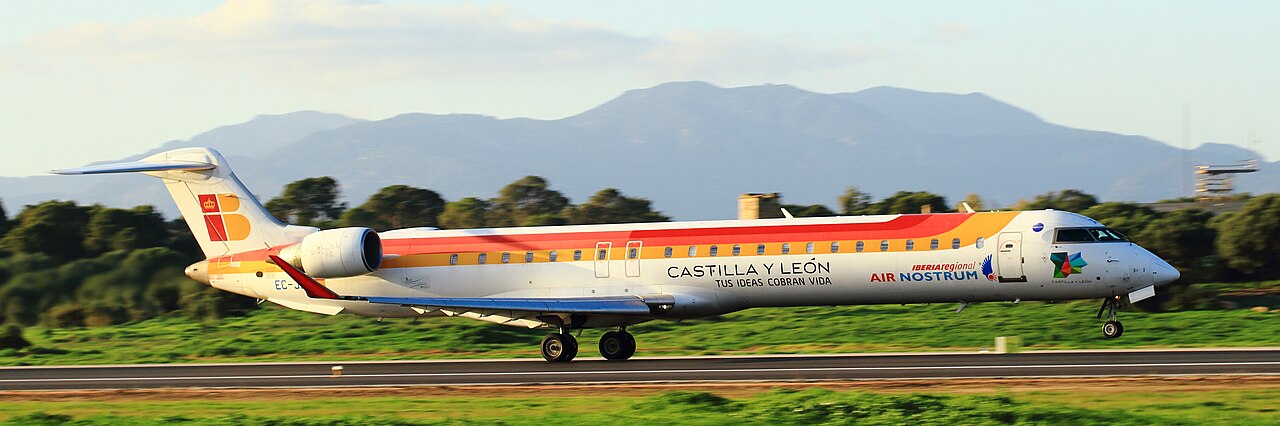
The Canadair Regional Jet, or CRJ, was developed from Challenger experience, with a lengthened fuselage and arrangements for passenger transport. The CRJ100 made its first flight in 1991 and entered service in 1992. Longer and higher-capacity versions followed, including the CRJ200, CRJ700, CRJ900 and CRJ1000. The aircraft were designed for regional markets and became common in airline and affiliated-carrier fleets. Their operation nevertheless depends on regulation, fuel costs, labour agreements and airline network structures.
CRJ programmes helped establish Bombardier as a recognised builder of smaller airliners. The family evolved through successive versions, with changes to cabins, engines and systems. Meanwhile, turboprops inherited from de Havilland Canada remained in production under Bombardier before that business was divested. The group also developed business aircraft, particularly the Challenger and Learjet lines, sustaining shared design and manufacturing capabilities while serving distinct commercial uses.
CSeries and the A220
In the mid-2000s Bombardier launched the CSeries, conceived as a family of twin-engine, single-aisle aircraft seating 100 to 150 passengers. The programme aimed at a new generation of aircraft, with extensive use of advanced materials and new-generation engines. International partners contributed to development and production, while final assembly was established in Mirabel, Quebec. The programme required substantial investment and experienced delays and financial difficulty before entering service.
The CS100 first flew in 2013 and entered commercial service with Swiss in July 2016 under the CS100 name. The CS300, later renamed A220-300, began operations the same year. In October 2017 Airbus joined the programme, announcing a partnership with Bombardier around the programme. The agreement was completed in July 2018: Airbus took a majority stake in the programme company, while Bombardier retained a minority interest. The aircraft was renamed Airbus A220 in July 2018. Mirabel assembly continued, and a second assembly line was established in Mobile, Alabama.
In February 2020 Airbus acquired Bombardier’s remaining interest in the programme, while Bombardier also transferred its stake to Investissement Québec. These transactions placed the programme under Airbus control. CSeries development gave Bombardier significant industrial and commercial experience, but its cost and financing requirements contributed to the group’s reorganisation. The A220 name now refers to the aircraft family, not a line marketed by Bombardier.
Divestitures and refocusing
From the second half of the 2010s, Bombardier reduced its commercial-aircraft activities and focused on business aviation. In November 2018 the company announced the sale of the Dash 8 programme to Longview, parent company of Viking; the transaction closed in June 2019. In 2020 it transferred the CRJ programme and related support activities to Mitsubishi Heavy Industries. The transaction closed in June 2020. Mitsubishi then assumed responsibility for CRJ operator support and services; Bombardier’s production sites were not transferred as an active aircraft production line.
Sales of its interests in the A220 programme and the divestiture of commercial-aircraft operations profoundly changed Bombardier’s place in aerospace. The group continued to build and support business aircraft, notably the Challenger and Global families. Global aircraft occupy the long-range business-jet segment, while Challengers serve other business-aviation requirements. Bombardier also retained service, maintenance and technical-support activities. This refocusing did not mean the company left aerospace; rather, its portfolio no longer included commercial-aircraft programmes in production.
The group’s history therefore brings together distinct paths: the Quebec company’s snow vehicles, Canadair’s aerospace legacy, acquisitions of aircraft makers, and development of the CRJ and CSeries. Commercial-aircraft activities were separated or sold, while the present company directs its aerospace business towards business aviation. The Canadair name remains associated with programmes and an industrial history whose significance extends beyond its period under Bombardier ownership. Distinguishing the historic company from current operations avoids confusing aircraft once built with the group’s present portfolio.
Notable aircraft
Other models
- Canadair CL-215
- Canadair CL-44
- Canadair Regional Jet (CRJ)
- Bombardier CSeries / Airbus A220
- Learjet 45
- Global 7500
Sources
- Encyclopædia Britannica — Bombardier
- Bombardier — Bombardier history
- Airbus — Airbus and Bombardier conclude C Series partnership
- Mitsubishi Heavy Industries — MHI completes acquisition of CRJ programme
Related reading
Manufacturer
AirbusManufacturer
de HavillandAircraft
Airbus A320