Manufacturer
Embraer
Founded in 1969, Brazilian manufacturer Embraer has grown from regional aircraft into business and defence aviation.
4 min read
Foundation and early aircraft
Embraer, short for Empresa Brasileira de Aeronáutica, was established in 1969 in São José dos Campos, in the state of São Paulo. Its creation formed part of a public policy to build a national aerospace industry. The region already hosted aviation research and training institutions, including the Aeronautics Institute of Technology, ITA, and the Technical Centre of Aeronautics. Engineer and air force officer Ozires Silva, who had helped advance the project, became the company’s first chief executive. Embraer thus began as a state-controlled company, drawing heavily on technical expertise developed in Brazil.
Its first major programme was the EMB 110 Bandeirante, a twin-engine aircraft designed for transport links and military missions. It first flew in 1968, before the company was formally established; series production began under Embraer. The design addressed the need to connect remote Brazilian cities and airfields with limited infrastructure. The Bandeirante was also exported, giving the young manufacturer experience in industrial production, certification and fleet support. It became a significant product in the development of Brazilian civil aviation, although it was not the company’s only aircraft.
In subsequent years Embraer built trainers, agricultural aircraft and transports. The Tucano, a turboprop military trainer, achieved export success. The company also developed the EMB 120 Brasília, a pressurised regional airliner for airline operations. These programmes broadened its capabilities and customer base, while leaving the company exposed to public-sector decisions, economic fluctuations and the financing challenges common to long-term aircraft development.
Privatisation and expansion
Financial difficulties in the late 1980s and early 1990s led to restructuring. Embraer was privatised in 1994; the state subsequently retained special powers connected with national defence, while control passed to private shareholders. Privatisation brought changes in management and a stronger pursuit of international markets. It did not remove public involvement from strategic programmes, but changed the conditions under which the company financed and marketed its aircraft.
The ERJ 145 programme, launched before privatisation, exemplified this direction. The fifty-seat regional jet first flew in 1995; it was delivered in late 1996 and entered commercial service in April 1997. Its design built on experience with regional turboprops while addressing demand for faster services on routes less dense than those served by larger narrow-body aircraft. Variants and related ERJ models followed, including the ERJ 135 and ERJ 140. Overseas sales, particularly to regional airlines, established Embraer as a major producer of regional jets.
Expansion also involved subsidiaries, industrial partnerships and a worldwide sales and maintenance network. Embraer did not build airliners alone: it remained active in defence aviation and developed business aircraft. Diversification reduced reliance on any one market, although all these activities remained exposed to order cycles, development costs and certification requirements in multiple jurisdictions.
E-Jets and diversification
In the early 2000s Embraer began a larger family than the ERJ 135 and 145. The E-Jets, including the E170, E175, E190 and E195, were designed around a common architecture in several capacities. The E170 first flew in 2002, and commercial deliveries began in 2004. The family enabled airlines to match capacity to medium-density routes and complement their narrow-body fleets. Shared features across variants can simplify training and operation, while differences in configuration and performance remain.
E-Jets found customers among network airlines, regional operators and lessors. Their success made Embraer a recognised competitor in the mid-capacity airliner segment. At the same time, the company broadened its business-aircraft offering with the Legacy and Phenom families, covering categories from light jets to larger-cabin aircraft. Defence activities include transport and surveillance aircraft and development of the KC-390, later designated the C-390 Millennium. This jet transport was developed with participation by the Brazilian state.
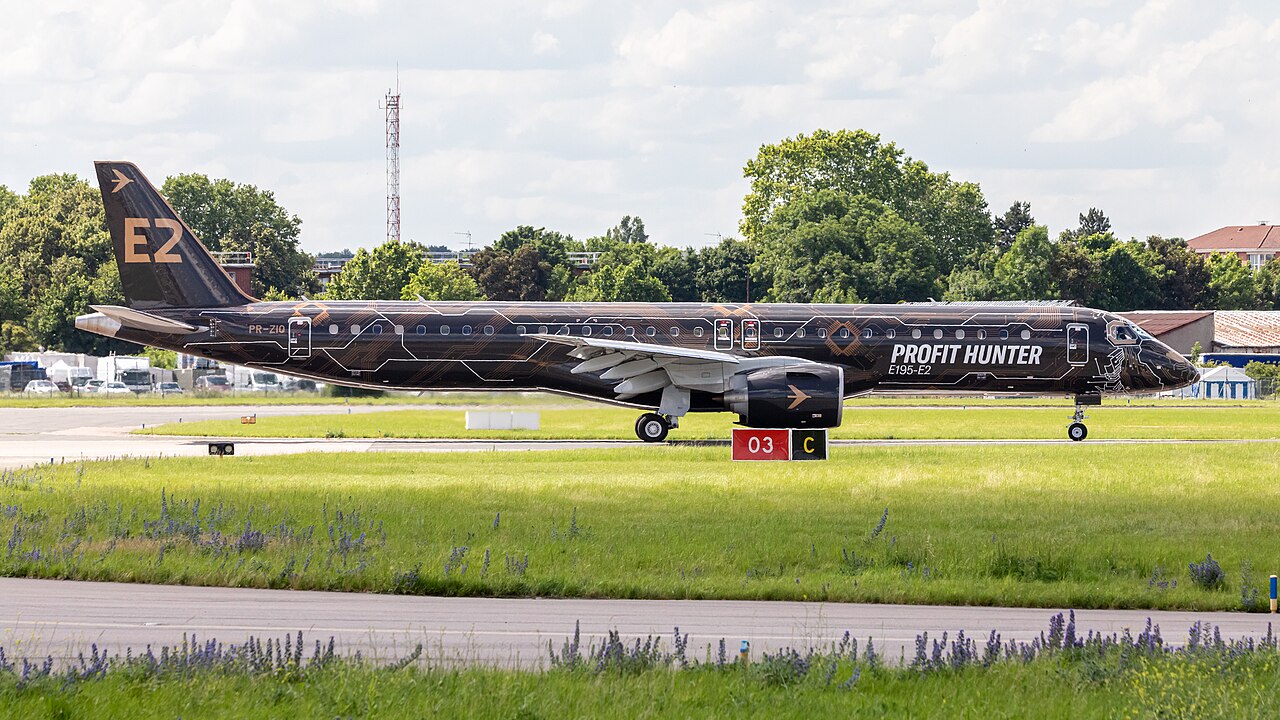
The E2 generation updated the E-Jet family with new engines, aerodynamic changes and revised systems. The E190-E2 and E195-E2 made their first flights in 2016 and 2017 respectively; initial deliveries followed in 2018 and 2019. Maintaining family continuity was intended to serve operators already familiar with E-Jets while improving fuel efficiency and capacity. Airlines nevertheless assess each version against their networks, operating costs and market conditions.
The Boeing proposal and the company today
In July 2018 Embraer and Boeing announced a proposed partnership in commercial aviation. The contemplated arrangement would have placed Embraer’s commercial aircraft and services business in a joint venture controlled by Boeing, while Embraer retained its defence and business-aviation activities. Embraer shareholders approved the proposal in February 2019, and it received regulatory clearances in several countries. It nevertheless prompted debate about governance, employment and the future industrial position of the Brazilian company.
Boeing terminated the proposal on 25 April 2020, stating that Embraer had not met certain closing conditions. Embraer disputed the decision and maintained that it had fulfilled its obligations; the companies subsequently entered arbitration. The joint venture therefore did not proceed, and Embraer remained independent. The two groups had separately agreed to cooperate on the KC-390, but Boeing terminated that arrangement in 2020. These events were distinct from Embraer’s other partnerships in defence and services.
Embraer continues to operate in four main areas: commercial aviation, business aviation, defence and services. It retains its headquarters and a substantial part of its industrial activity in São José dos Campos, alongside sites and subsidiaries abroad. Regional jets distinguish its commercial business, while business aircraft and military products serve different markets. Production, orders and deliveries are affected by economic conditions, certification schedules and supply chains. The company is therefore both an exporting manufacturer and an element of Brazilian industrial policy.
Notable aircraft
Other models
- EMB 110 Bandeirante
- EMB 120 Brasília
- ERJ 145
- E-Jets
- E-Jets E2
- KC-390 Millennium
Sources
- Encyclopædia Britannica — Embraer
- Embraer — Embraer History
- Reuters — Boeing ends joint venture with Embraer
Related reading
Manufacturer
BoeingManufacturer
AirbusAircraft
ATR 42 / ATR 72