Manufacturer
Saab
Saab is a Swedish manufacturer originating in the defence industry, known for military and regional aircraft.
3 min read
Origins
Svenska Aeroplan Aktiebolaget, known as Saab, was established in 1937 to develop Swedish aviation capability. Its industrial origins are associated with Trollhättan, while Linköping became a major design and production centre. The company’s formation reflected European rearmament and Sweden’s aim to equip its armed forces with aircraft of its own. It brought together engineers, workshops and the capabilities needed to design complete aircraft.
Early work included licensed production and adaptation of existing aircraft. Manufacturing experience provided a basis for national designs. Saab gradually developed design teams able to manage airframes, systems and testing. As a neutral country during the Second World War, Sweden enabled the company to continue industrial activity while meeting national defence requirements. This origin explains the lasting importance of military aviation in its history.
Growth
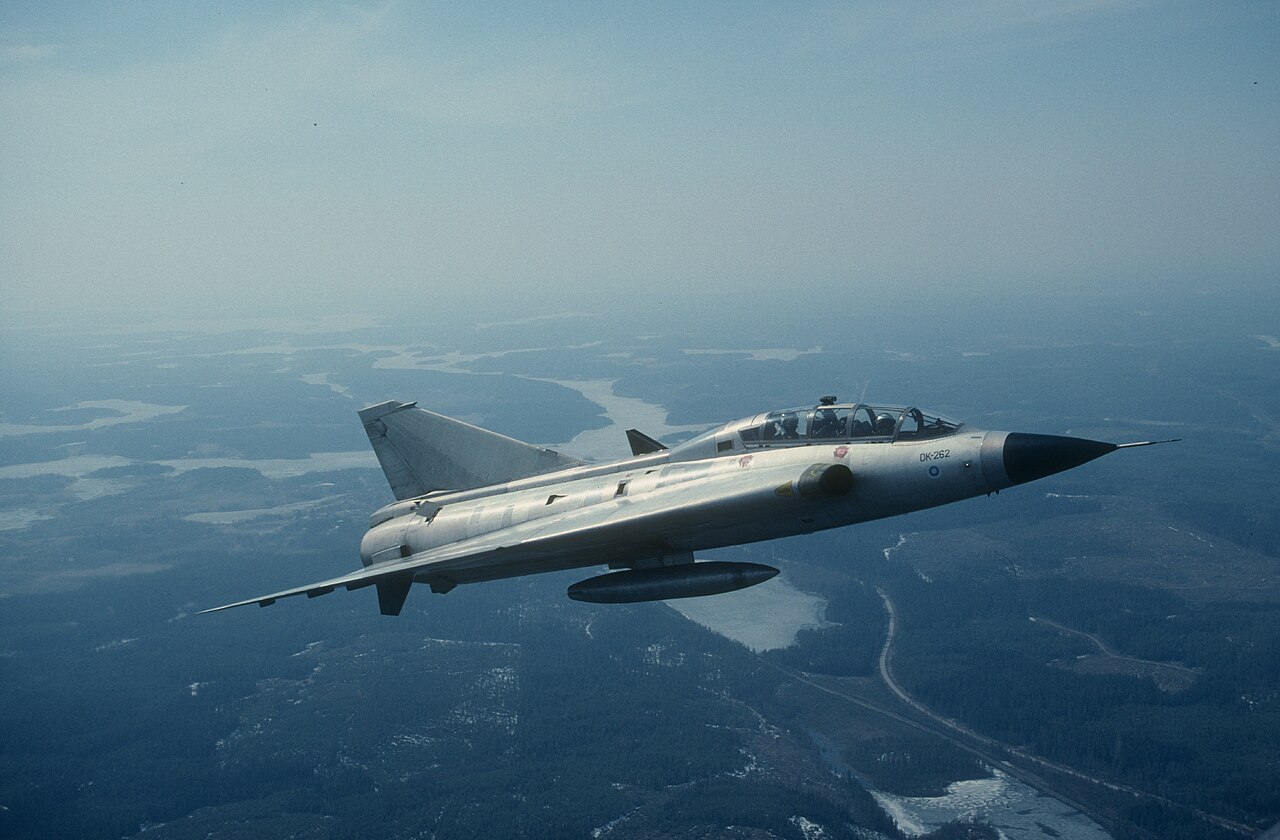
After 1945, Saab continued designing aircraft for Swedish requirements. The rapid transition to turbojet power brought new demands in aerodynamics, propulsion and systems. The J 29 Tunnan, which first flew on 1 September 1948, was a swept-wing jet fighter. It was followed by the J 32 Lansen, designed for several missions, and the 35 Draken, notable for its double-delta wing, which first flew on 25 October 1955 and entered service in 1960. These aircraft demonstrated the engineering effort of a relatively small country.
Swedish defence policy emphasised dispersal and operations from austere bases. Saab aircraft were therefore designed as part of a system including maintenance, ground equipment and operating procedures. The 37 Viggen combined several roles and a configuration suited to short runways; it entered service in the early 1970s. These programmes accompanied changes in the jet age and the development of integrated systems.
Major programmes
The JAS 39 Gripen extended this tradition with a multirole combat aircraft designed around Swedish requirements. The programme emphasised a compact airframe, integrated avionics and the ability to operate from dispersed facilities. The Gripen first flew in 1988 and entered Swedish air force service in the 1990s. Later versions updated its systems and broadened export opportunities. The programme was developed with industrial partners and international suppliers.
Saab also diversified into regional transport. The Saab 340, a twin-turboprop developed with Fairchild, first flew in 1983; the larger and faster Saab 2000 first flew in 1992. Both served regional routes and specialist markets. Production ended in 1999, although aircraft remained in operation. This civil branch gave the manufacturer certification and support experience distinct from that of combat aircraft.
Mergers and acquisitions
Saab’s history is part of a wider Swedish industrial story. In 1969 the company merged with vehicle manufacturer Scania to form Saab-Scania. Aviation and automotive activities remained identifiable within the group. Saab Automobile was separated in 1990, and in 1995 Saab-Scania was split into Saab AB and Scania. Saab AB retained its defence and aerospace activities.
At the turn of the twenty-first century, Saab reorganised its civil aviation presence. It divested its regional aircraft activities and focused more strongly on defence, military aerospace, sensors and systems. Changes in ownership and portfolio did not eliminate all aeronautical expertise: combat aircraft design and integration remained central. Saab, however, no longer builds civil airliners.
Today
Saab AB remains a defence and technology group whose activities include military aviation, surveillance systems, equipment and services. Linköping remains associated with aerospace development and production. The Gripen is its current combat-aircraft programme, operated by Sweden and several foreign customers. The company works through international partnerships, supply chains and public contracts.
The Saab 340 and 2000 regional aircraft continue to represent its former civil activity, while preserved fighters trace the development of Swedish aviation after the war. Saab’s expertise today is expressed primarily in defence and integrated systems rather than civil transport-aircraft production. Its history connects national industrialisation in the 1930s with a specialised company operating in global markets.
Experience gained through these programmes extends beyond the airframe. A military aircraft must be integrated with its sensors, weapons, communications and maintenance system. Saab has developed expertise in these areas and in updating them during an aircraft’s operational life. Modernising an aircraft requires testing and validation of interfaces so new equipment works with systems already installed. This continuity helps explain the persistence of an aerospace business after civil production ended.
The Gripen E is a substantially developed Gripen, rather than an aircraft unrelated to earlier versions. It incorporates updated equipment and systems, as well as airframe and stores changes. Development takes place through international cooperation involving suppliers in several countries. As with any modern combat aircraft, an assessment must distinguish advertised capabilities, equipment actually delivered and the configurations selected by each operator.
Notable aircraft
Other models
- J 29 Tunnan
- 35 Draken
- 37 Viggen
- JAS 39 Gripen
- Saab 340
- Saab 2000
Sources
- Encyclopædia Britannica — Saab
- Encyclopædia Britannica — History of flight
Related reading
Manufacturer
JunkersManufacturer
ATRAircraft
Junkers Ju 52