Manufacturer
Nord Aviation
Emerging from SNCAN, Nord Aviation built transport aircraft and missiles before joining Aérospatiale in 1970.
4 min read
Origins and nationalisation
The history of Nord Aviation begins with the nationalisation of French aircraft manufacturing in 1936-1937. The French state brought private establishments together within several regional national companies. Société nationale de constructions aéronautiques du Nord, or SNCAN, received the Potez factory at Méaulte in the Somme, among other facilities. It also took over resources from other manufacturers. This was a combination of industrial operations and design offices rather than the immediate creation of an entirely new aircraft range. Existing products and capabilities therefore continued to shape the organisation during its early years.
The Méaulte establishment remained part of this industrial continuity, from Potez manufacturing to the aircraft structures of subsequent generations. SNCAN passed through the war and then participated in rebuilding the French aircraft industry after 1945. It worked on several categories of aircraft, including transports and light aircraft. Like the companies from which Sud Aviation emerged, it combined production facilities with design teams inherited from before the war. Successive reorganisations changed corporate names without erasing the underlying geography of the industry.
Growth from SNCAN to Nord Aviation
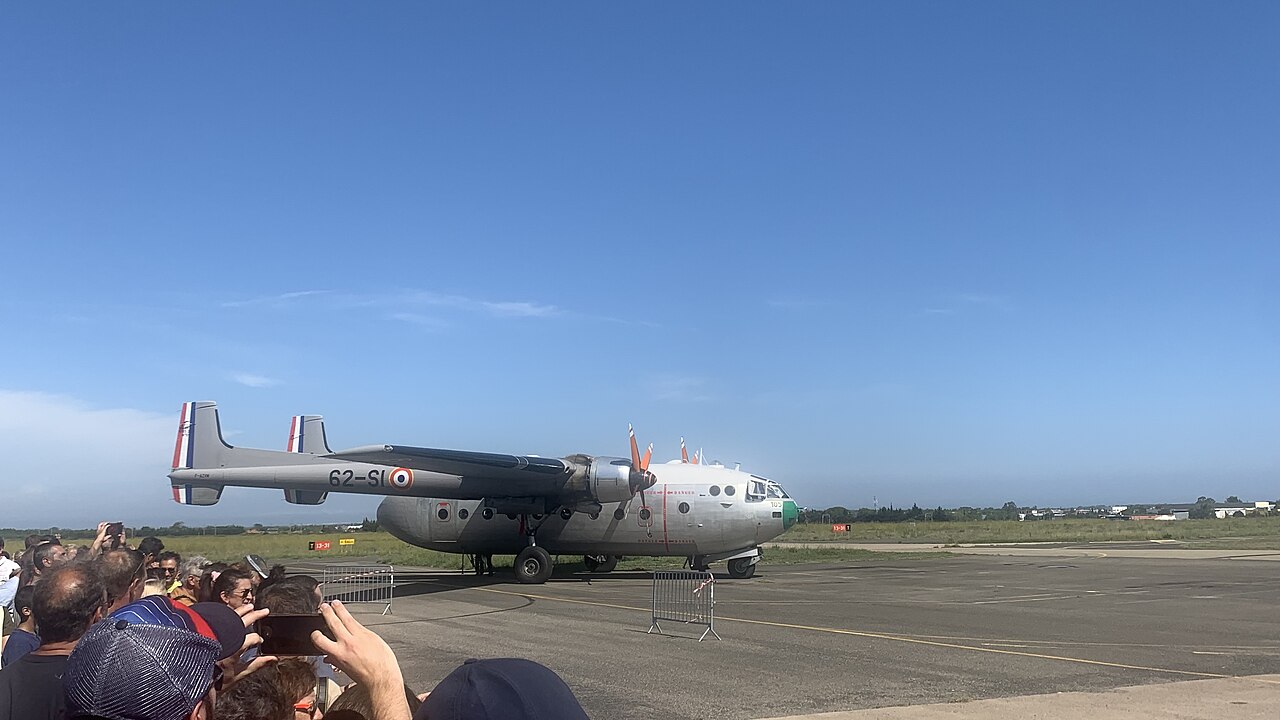
The Nord 2501 Noratlas illustrates this recovery. The N.2500 prototype flew in 1949 under SNCAN responsibility; the production N.2501 flew afterwards. This twin-engined, twin-boom transport had a rear-access cargo compartment suited to freight and military missions. Its customers included the French and West German armed forces. Licensed production in West Germany established relationships between manufacturers in the two countries before the development of the Transall. The aircraft consequently belongs to the history of both SNCAN and Nord Aviation, which continued its manufacture after the change of company name.
In 1954 SNCAN absorbed Société française d’étude et de construction de matériels aéronautiques spéciaux, or SFECMAS, which had emerged from the Arsenal de l’aéronautique, and subsequently adopted the name Nord Aviation. This combination brought work on experimental aircraft and guided weapons. Sources differ on the exact date of the change of name. Research on the Gerfaut and Griffon aircraft illustrates contemporary work on high speeds, using propulsion arrangements and configurations different from those employed on transport aircraft.
Major transport programmes
The C-160 emerged from cooperation between France and West Germany. The Transall consortium brought Nord Aviation together with Weser Flugzeugbau and Hamburger Flugzeugbau. The prototype flew on 25 February 1963. Powered by two turboprop engines and equipped with a rear ramp, the aircraft was intended for tactical military transport. Design, manufacture and assembly were distributed among the partners. Initial deliveries to the French armed forces took place in 1967, followed by deliveries to Germany. This industrial arrangement preceded the European combinations that would lead much later to EADS.
Nord Aviation also developed the Nord 262, a regional transport with a pressurised cabin and two turboprop engines. Derived from Max Holste’s work on the Super Broussard, it made its first flight in 1962. Civil and military operators used it on routes requiring less capacity than jet airliners. Its place in the product range demonstrates that Nord was not confined to military aircraft. At the same time, Sud Aviation was building the Caravelle, which addressed a different segment of the commercial air transport market.
Missiles and diversification
Missiles formed another area of Nord Aviation’s business. The company produced the SS.10 and SS.11 anti-tank weapons, developed from French work on wire guidance. Their operation relied on commands transmitted through a wire connecting the weapon to its control station. These systems were designed for military use and were exported. The SS.11 could be deployed from different platforms, including helicopters. This business required expertise in aerodynamics, propulsion, guidance and the integration of complete systems, alongside capabilities associated with aircraft design and production.
Entac, another French wire-guided anti-tank weapon of the period, was developed by the French Army’s technical services (DTAT). Development of the Exocet (MM38) began at Nord Aviation in 1967 before continuing at Aérospatiale. Missiles were therefore not simply an adjunct to aircraft construction. They constituted an industrial sector with their own users and technical requirements. This diversity helps explain the composition of the successor group: Aérospatiale combined transport aircraft, helicopters, missiles and space-related activities rather than concentrating on a single family of aircraft or one particular type of customer.
Merger and industrial legacy
With effect from 1 January 1970, Nord Aviation was combined with Sud Aviation and Société pour l’étude et la réalisation d’engins balistiques, or SEREB, within Société nationale industrielle aérospatiale. Known as Aérospatiale, the new company took over their programmes and resources. Nord Aviation ceased to exist as an independent manufacturer, but its products did not disappear with its name. Teams, facilities and contracts were incorporated into the new organisation. Continued work on the Transall illustrates the industrial continuity extending beyond the formal merger of the companies.
Today Nord Aviation denotes a historical company, not an independently operating manufacturer. Its legacy can be traced through several branches created by later combinations, including businesses associated with Airbus and missile production. This industrial lineage must nevertheless be distinguished from programme attribution: Airbus airliners were not Nord Aviation designs. The Noratlas, C-160, Nord 262 and guided weapons define the company’s own contribution to French industrial reconstruction and to the early stages of European cooperation in aircraft manufacturing after the Second World War.
Notable aircraft
Other models
- Nord 2501 Noratlas
- Transall C-160
- Nord 262
- SS.10 / SS.11
- Exocet MM38 (development begun, 1967)
Sources
- Airbus — Our history
- Airbus — The Transall Turns 60
- Service historique de la Défense — Société nationale de constructions aéronautiques du Nord, puis Nord Aviation
Related reading
Manufacturer
Sud AviationManufacturer
AérospatialeManufacturer
AirbusManufacturer
EADS